GaitMate
Developing wearable biosensing technology and real-time feedback tools for a smarter injury recovery.
We are developing wearable biosensing technology designed to make injury recovery, rehabilitation, and movement monitoring more accessible, personalized, and data-driven. Our platform combines a wearable biosensing sticker with real-time software analytics to help users better understand movement patterns, gait asymmetries, and recovery progress. By translating biomechanical and physiological data into actionable feedback, we aim to support safer rehabilitation, improved mobility, and more informed recovery decisions.
Founded by a multidisciplinary team with backgrounds in bioengineering, bioinformatics, and health technology, our work sits at the intersection of wearable devices, digital health, and human performance.
Demo ↗Hackathon prototype repository · Not a clinically validated application
THE PROBLEM
Approximately 2 million ankle sprains occur annually in the United States, with lateral ankle sprains accounting for the majority of these injuries. Reinjury and chronic ankle instability can complicate recovery, while rehabilitation often takes place outside supervised clinical sessions.
Gait changes are also relevant beyond sports injuries. Altered walking speed, asymmetry, balance, and stability can occur with neurological disorders, acquired brain or spinal injuries, neuromuscular conditions, and age-related mobility decline.
Their causes and clinical meaning vary by condition, but they share a need for careful movement assessment. Our goal is to explore how accessible longitudinal monitoring could complement, rather than replace, clinical care.
OUR MISSION
Our mission is to investigate wearable tools that help people and care teams recognize changes in movement and rehabilitation progress between appointments. We began with localized sensing for lateral ankle injury recovery and are expanding our research direction toward gait analysis across a broader range of conditions.
Areas of interest include gait disturbances in Parkinson's disease and multiple sclerosis; movement changes following traumatic brain injury, spinal cord injury, and stroke; neuromuscular conditions such as cerebral palsy and Duchenne muscular dystrophy; and identifying mobility patterns that may contribute to fall risk in older adults.
Our long-term vision extends beyond detecting abnormal movement after it occurs. We hope to investigate whether changes in gait and other biomechanical signals can help identify emerging mobility concerns, support preventive interventions, and provide a more personalized understanding of recovery over time.
Predicting falls and providing disease-specific assessments remain future research goals requiring dedicated technical and clinical validation.
OUR TECHNOLOGY
GaitMate's wearable biosensing sticker concept monitors movement and localized biomechanical strain near an injured ligament during rehabilitation.
Each sticker uses a three-layer architecture: a waterproof exterior cover, a middle sensing layer, and a skin-safe adhesive layer. Our initial design investigates a compact, hydrocolloid-patch-sized wearable format.
Our proposed system connects sensor information with a mobile interface for real-time recovery feedback, movement visualization, and longitudinal monitoring. The hardware and wearable integration remain under development.
Read more about our technology →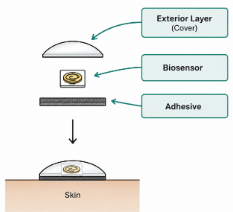
RESEARCH & DEVELOPMENT
Our initial research explores a nine-sensor configuration around the lateral ankle, with three sensing locations associated with each of the anterior talofibular (ATFL), calcaneofibular (CFL), and posterior talofibular (PTFL) ligament regions.
Current development focuses on sensor selection, prototype construction, benchtop characterization, wearable integration, and evaluating how movement measurements could be translated into meaningful rehabilitation feedback.
Our longer-term vision is to investigate how wearable sensing could contribute to preventive care and rehabilitation across neurodegenerative disorders, acquired brain and spinal injuries, neuromuscular conditions, and aging-related mobility challenges. Each application will require its own research, sensing strategy, and clinical validation.
Explore our research & development →