Piezoresistive Strain Sensors
Measure changes in electrical resistance caused by mechanical deformation. These sensors may provide a flexible approach to localized stretch monitoring.
TECHNOLOGY
GaitMate combines a wearable biosensing sticker concept with a digital rehabilitation platform to investigate how movement and biomechanical measurements can support more personalized injury recovery.
Our hardware and software are being developed iteratively, beginning with localized ankle monitoring and expanding toward broader gait analysis applications.
HARDWARE
GaitMate's hardware is currently under development. Our initial design investigates multiple sensing locations around the lateral ankle to capture localized biomechanical changes during movement.
We are exploring several sensor technologies, including piezoresistive strain sensors, capacitive stretch sensors, inertial measurement units (IMUs), and electromyography (EMG). Each modality offers different information about deformation, motion, or muscle activity.
Measure changes in electrical resistance caused by mechanical deformation. These sensors may provide a flexible approach to localized stretch monitoring.
Measure deformation through changes in capacitance. Their flexible structure makes them a potential candidate for wearable movement sensing.
Combine accelerometer and gyroscope measurements, sometimes with magnetometers, to characterize movement, acceleration, and orientation.
Measures electrical activity associated with muscle activation and may provide complementary information about neuromuscular function.
WEARABLE BIOSENSING STICKER
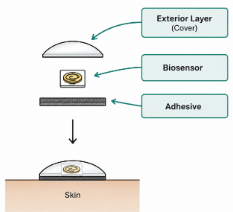
Our proposed wearable sticker is designed around a hydrocolloid-patch-sized format, with three functional layers intended to support sensing during rehabilitation.
A waterproof covering intended to protect sensing components from environmental exposure during everyday use.
Contains the selected sensor technology and associated connections used to capture movement or localized biomechanical measurements.
An adhesive interface intended to maintain sensor placement while accommodating movement and minimizing skin irritation.
INITIAL SENSOR CONFIGURATION
Our initial ankle rehabilitation concept proposes nine sensing locations, organized into three groups associated with the major lateral ankle ligament regions.
Three sensors are proposed near each ligament region to investigate how measurements vary spatially during movement. The configuration is a research design, and the ability to infer ligament strain from skin-mounted sensors has not yet been established.
Anterior talofibular ligament region. An important focus in lateral ankle sprain research.
Calcaneofibular ligament region. Included to investigate localized mechanical behavior around the lateral ankle.
Posterior talofibular ligament region. Included in the proposed multi-location sensing architecture.
SOFTWARE
GaitMate's initial app design was scaffolded during the UCSF QBI Hackathon. The prototype explores how movement and rehabilitation information could be displayed through an accessible digital interface.
Our software development roadmap includes real-time strain visualization, movement-event detection, rehabilitation progress tracking, and personalized exercise guidance.
A proposed three-level visualization communicates relative strain or loading categories.
Early thresholds are informed by literature-based assumptions and require experimental calibration before being interpreted as patient-specific risk.
Planned movement-event detection aims to identify patterns consistent with falls or instability and support timely feedback.
Longer-term research will investigate whether changes in gait, balance, and movement variability could contribute to estimating fall risk.
A proposed exercise-guidance feature would organize rehabilitation activities using recovery stage, injury history, and movement measurements.
Future versions would require clinician-reviewed exercise protocols and validation before providing individualized therapeutic recommendations.
DATA & ANALYTICS
Our planned analysis pipeline connects wearable measurements with interpretable indicators of movement and recovery.
Record movement-related signals such as localized deformation, acceleration, orientation, or muscle activity, depending on the selected sensors.
Explore signal changes, asymmetry, variability, and movement patterns across activities and time.
Present movement information through visual summaries, progress trends, and proposed feedback categories for patients and clinicians.
Hardware integration, clinical interpretation, and validated real-time performance remain ongoing development goals.
APPLICATION PROTOTYPE
The GaitMate Hackathon repository documents our early application work and provides a foundation for continued development of the digital platform.
View Demo Repository ↗